
Review/discussion about: World Trigger
by BanjoTheBear

Bah humbug
I have a personal tradition for Christmas.
Every time the holidays roll around, and I am out and about getting gifts for my parents, I always make sure to pick them up a couple of ornaments. A new Santa one for my father, and a new snowman one for my mother. Fancy. Cute. Interesting. Whatever the make, I make sure that whichever I choose is a fun one to unwrap.
If World Trigger were a gift, I would never give it to my parents. I would never give it to any of my friends or strangers on the street. I wouldn’t even give it to my sworn nemesis.
It’s that deplorable.
STORY
In a world where evil Neighbors invade and Triggers are used, Osamu, a teenage boy yearning to become a member of the protective Border Agency, has a fateful encounter with an even younger boy named Yuma. Yuma, as it turns out, is also a Neighbor, but he has come to make peace not war. These two, together with their close friend Chika, find themselves supporting one another as they face the troubles laid out on their path.
This description is not a thorough one for World Trigger, for the anime is seventy-three episodes long. True, it is not as long as those most popular, long-running shows, but seventy-three is not a number to scoff. After all, the majority of anime are either twelve or twenty-four episodes in length.
Unfortunately, its length is also its downfall.
Repetition is a concept that many people are familiar with. Especially if they watch anime or take part in discussing them. Repetition can be a positive if it is used as a plot point or as a thematic element. Often, though, it is a negative, demonstrating a show’s inability to add variety or a need to linger on the same events, outcomes, and character appeals.
World Trigger takes it several leaps further.
It’s almost astounding how much the show repeats itself. Take its in-world knowledge. The different weapons, the types of Neighbors, how the structure of Border works. A lot of time is set aside to explain these arguably minor details. A smart move. Giving the audience more about how everything operates is (usually) worthwhile.
But, in what can only be described as a blunder, the anime has this segment at the end of almost every episode called “World Trigger Fun Facts.” There, they repeat much of the same information that was already given. Those weapons? Here they are again with next to nothing new added. Those Neighbors? Covered once more with the same information. Those rankings? S, A, B, C is “tough” to remember, so it’ll be wise to break it down again.
These “fun” facts do not stop here because, once the anime reaches roughly past the halfway mark, it begins to repeat the same info from previous segments. The guns, the Neighbors, the rankings. A lot of it is repeated – again.
Repetition continues with Yuma’s infamous pout where, for “comedic” purposes, Yuma purses his lips and dons three horizontal lines for eyes. A repeated gesture that is basically a characteristic but gets used in almost every situation by him (and others). (Thankfully, the anime calms this down a bit as events get more serious later, but it still appears at a nominal rate.)
How about always displaying the names, ages, and roles of the different characters no matter how many times they are seen? The invariance of enemies? A need to litter every battle with explanatory dialogue rather than letting them play out?
Yet the worst (best?) example is each episode’s opening. In almost every single episode, the anime replays a fixed reel with narration played on top of it. While it can change when the arc does – about once every fifteen episodes or so (so about five different sets in total) – it takes up roughly a minute and thirty seconds of that episode’s time. Which in turn takes away the show’s chances of doing something not repetitive.
The kicker? The anime will then proceed to replay exact scenes from the previous episode. As though the reels were not repetitive enough, the show makes its audience sit through reused material that contains verbatim dialogue and replicated events as if it’s expected.
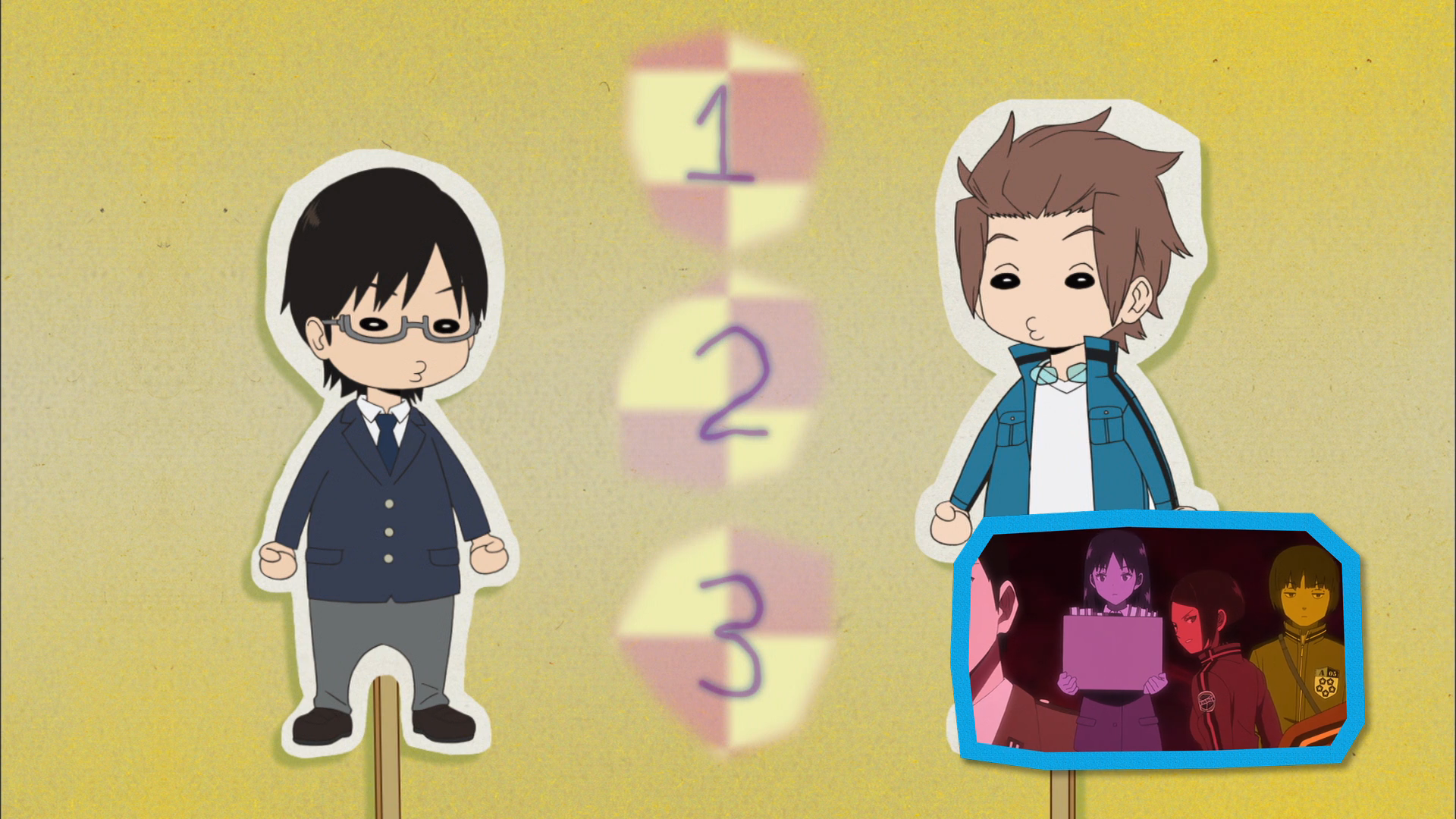
Repetition roots itself everywhere
Episode forty-one is particularly egregious: The first four minutes and twenty seconds are literally the overused reel and copy-pasted content from the previous episode.
The repetition is horrible, but, somehow, the anime does not stop hitting itself in the face.
Pacing manages to be a problem. The first arc is recognizably slow as the show takes way too much time in setting up its characters, world, and general atmosphere for roughly twenty-one episodes. During this span, the anime does have a couple of battles and a bigger fight break out to help minimize the monotony, but it is still noticeably slowed down.
From episode twenty-two to thirty-five, the anime enters its large-scale-Neighborhood-invasion arc, and it is at this point that pacing goes out the portal. Over the course of these fourteen episodes, the anime stretches out hours of in-world time, slowing everything down again. It even goes so far as to extend seconds of in-world time (into minutes of airing time), killing any reasoning for the pacing.
World Trigger gets its pacing wrong again when it halts the progression of its B-Rank-Wars arc in favor of the Xeno-and-Lilith arc. Doing so killed the build-up, the sense of progression that Osamu, Yuma, and Chika had been making. It resumes the B-Rank-Wars arc later, sure, but, by that point, the paced-based damage had been done.
And as if the show could not get any worse, it makes some questionable choices throughout its run.
That Xeno-and-Lilith arc has no consequence on the events within the season. The idea is that what the group did will pay dividends sometime in the future. But, for the here and now, the arc represents nothing more than an unnecessary diversion (especially since they were supposed to be training but had to deal with this whole conflict instead).
The idea behind triggers switching out one’s physical body for a virtual one, while futuristic, removes a lot of tension since their actual bodies are in no real danger.
Episode sixty interjects the arc that already interjected the arc before it. It’s meant to be a comedic one-off starring “Tamakoma branch’s most powerful member,” but it has no place in the occurring narrative.
Even how the season concludes raises eyebrows. It chooses to make the cutoff right as the newest Neighbor invasion starts as well as right before Osamu and the others go into the pivotal B-Rank match.
The latter tears the muscles around the eye. They aimed to win the B-Rank wars (and thus go on the away missions into the Neighborhood) all the way back in episode eleven. Meaning, even after the remaining sixty or so episodes unravel, the show fails to accomplish its original goal for the season.
All these problems are bad on their own, but, again, they occur across seventy-three episodes. In other words, the repetition, the pacing, and the poor writing choices are each compounded, exacerbated by the long length of the season, turning these problems from intolerable to wholly insufferable.
ANIMATION
World Trigger has a clear positive in its visual arsenal: The trigger transformation sequence. Blue-and-purple, space-like effects spread over the characters as their virtual bodies replace their physical ones. It’s fancy-looking, and it works.
But it’s repetitive.
Oh, do not be mistaken. Repetition does not stop with the story. The transformation gets a pass because it at least tries to be interesting. But Yuma’s squinting face? The drab teal outfits? Osamu’s glasses constantly fogging up on only one lens to make him seem serious when, in actuality, it only makes it look as if he does not treat his eyewear with proper care?
The setting, too. The show almost exclusively takes place in the same city and within the same Border headquarters. It would not be a problem if the anime attempted to spruce up these areas given that they are seen all the time. Nope. It’s the same low-detailed, repetitive locations.
It does try to break up the monotony with its weapons and its enemies, but these, too, suffer from lack of intrigue. The weapons are mostly swords and shields (and their variants) that go without any distinguishing characteristics besides their yellow-laser composition. And the enemies are giant, bug-like creatures that go featureless save for their same giant-eye weak-point.
Among the rough, its Black Triggers, which it claims are powerful and unique, are, in fact, powerful and unique. Portal creation, translucent-Trion-coagulating birds, and an all-reaching blade stake their claim as the top-tier gear. If only because everything else is so abysmally tame. (Indeed, the Black Triggers make one wonder what could have been had the show given a similar level of attention to its other parts.)
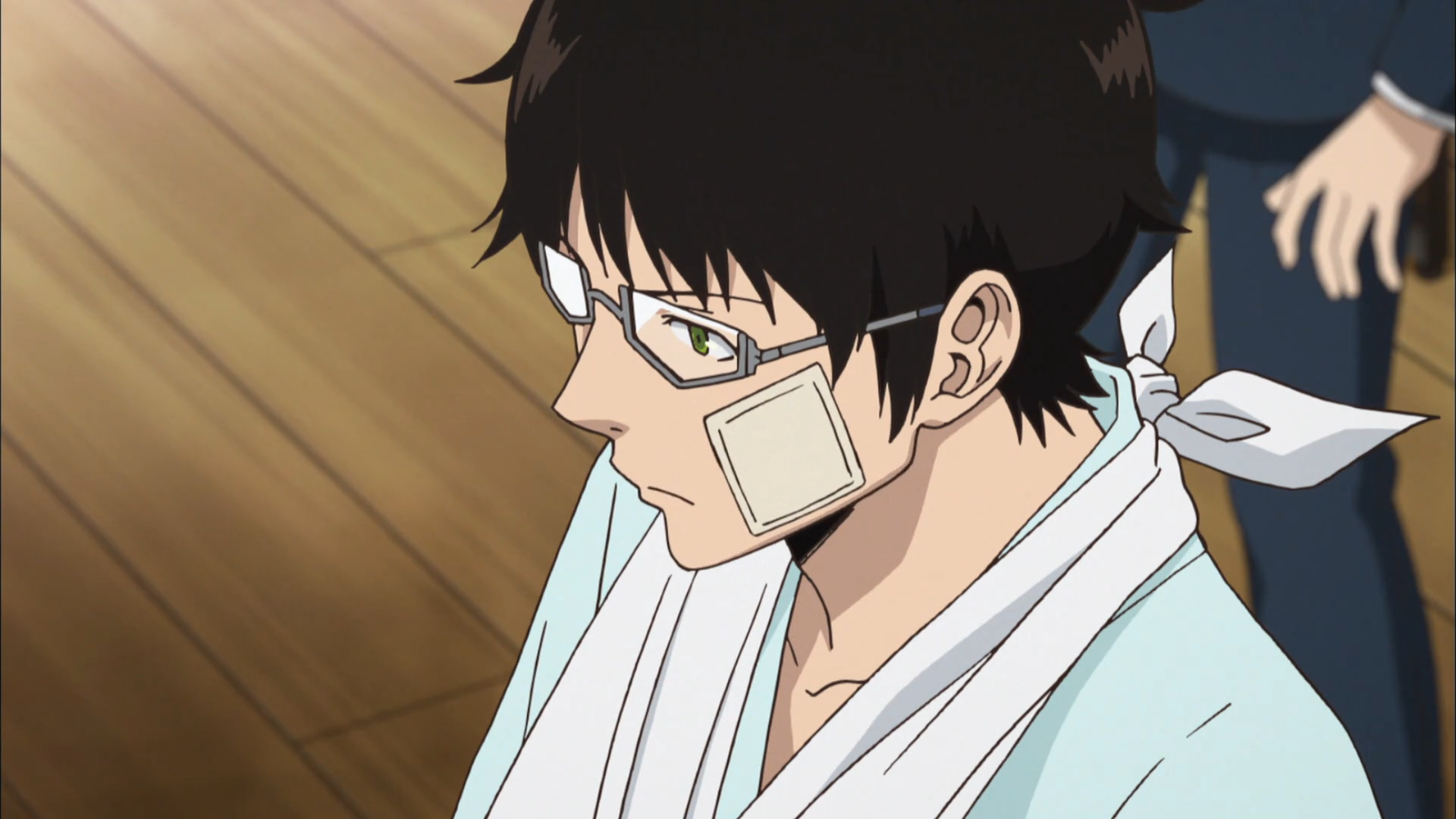
Osamu needs to get new glasses
At the very least, the anime’s character designs are not awful. Yes, Osamu is too plain, Chika’s mouth is oddly triangular, and Yuma already needs to dye his hair as a teenager. But, considering the size of the cast, the changes to hair color, pupil formation, body image, styles, and accessories help to differentiate the characters while also giving them their own personalities. Kirie, in particular, gets a brand-new look when she turns on her trigger: a winged hairstyle as well as a light-green outfit.
Then it goes right back to being intolerable with subpar actual animation. The fights are not given enough room to breathe, characters usually only move their mouths, and everybody has a hard time even walking around the room as they discuss the same set of topics for the umpteenth time. At least the glowing cube pieces dart around, right?
A few negative shout-outs are still in order.
The first goes to the visuals for the second ML (acronym explained later) track. Having each character “sing” a portion of the song is not cool in the slightest. Especially when Chika, a female, lip syncs a male’s voice.
The second goes to the final episode. It is somehow leagues worse than all the episodes before it. Disproportionate heads, stiff animation, and weak choreography end the anime with even more distaste.
The third goes to the “fun” facts epilogues. They went cutesy and minimalist to fit their “fun” mood, but it really just seems as though the anime was cutting corners with the cutouts.
CHARACTERS
World Trigger is yet another anime with a massive cast, reaching about one-hundred distinct characters. Therefore, just the main four will be investigated: Chika, Jin, Yuma, and Osamu.
Chika is a young girl who finds herself attracting the evil Neighbors. It’s not her fault, for she simply contains an unbelievable amount of Trion (especially for someone of her size). Her indirect relation with the Neighbors caused her to distance herself from others in order to protect them, leaving her in a spot without too many friends.
Unfortunately for Chika, and early on, the show reveals that not only did the Neighbors kidnap one of her close friends, but also her brother went missing beyond the rift, too. In retaliation, Chika enlists herself at Border to save those that were taken from her.
Her gargantuan Trion levels made her gun-type role a no-brainer. With a sniper in tow, she can literally raze entire hills, earning her the nickname “Cannon.”
The beginning of the season only gives the audience the tidbits to her background and motivations. The middle section has her being the target of Aftokrator because, to them, she is the “golden baby bird” they were seeking. In other words, Chika does not do a whole lot for a long while.
Not until the last one-third or so does a new characteristic officially enter the field: She cannot shoot people.
Her mental obstacle is extremely annoying since it comes off as a cheap excuse to stop her from decimating the competition (when most of her foes are in no danger of dying anyway). But it does give her the chance to grow. She eventually manages to fire her gun as well as changes to a different setup that plays to her strengths. Namely, her huge store of Trion.
Is Chika a strong character? No. Mostly since she’s relegated to the side without accomplishing much. However, she’s the best of the four – and that is telling.
Jin is notable for his amazing “Side Effect,” special abilities that certain characters possess. His Side Effect is reading the future. He cannot predict it, but he can see the various intersections as well as influence which one the world could take.
If that were not enough, he has his own Black Trigger, making him one of, if not the, most powerful Border agent.
Jin does receive some attention early on, being the one that inspired Osamu to put his all into joining Border. And he interacts with Osamu and his group often enough, getting them a spot at his branch as well as looking out for them elsewhere.
Unfortunately, his character starts to go downhill shortly after.
Jin gives up his Black Trigger, sensing (through his Side Effect) that it would be for the best to let others wield it, reducing his overall impact and coolness. Then, after warning about Osamu’s potential death during the Aftokrator arc, he basically vanishes, appearing only a handful of times without having any impact on the events at hand.
Jin even (way later) turns down Osamu’s invite to their group, a bold move to make Osamu’s team that much stronger.
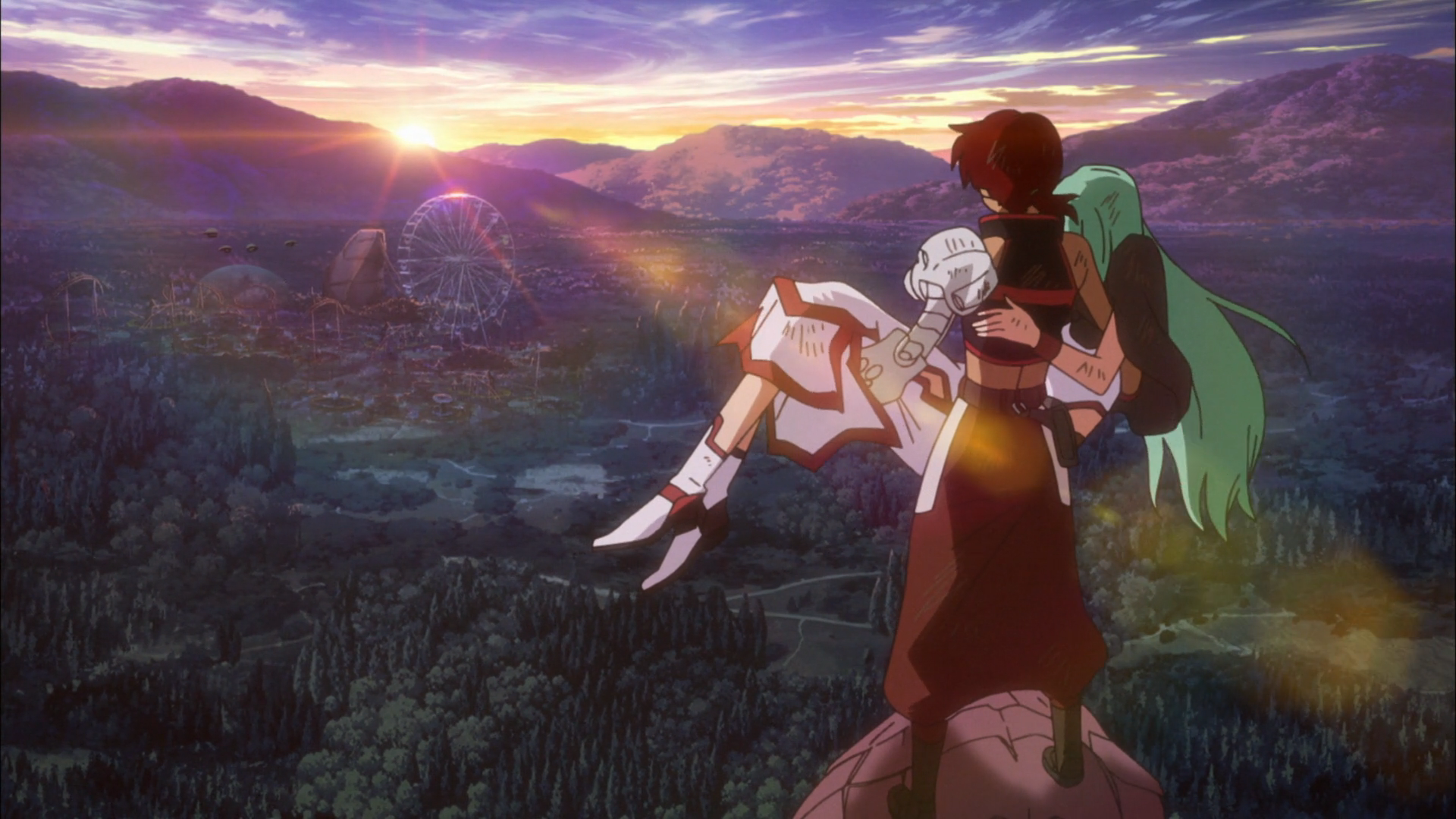
Xeno’s arc is better than the arcs of the main four combined
Which begs the question: Why is Jin even considered a main character let alone plastered on the front of the anime’s main graphic? His background is not investigated, he does not have an internal conflict, and he sits on the sidelines for a large chunk of the show. In all regards, he’s a massive step down from Chika.
Yuma is technically a stronger character than Jin but not by much. Yuma is a humanoid Neighbor, something that Osamu and the others had never heard of before. Yuma, alongside his trusty pal Replica, has a Black Trigger of his own, granting him boosted powers and increased battle prowess.
But, as his background shows, he does not necessarily need it. When he was in the Neighborhood, he was with his dad, learning about fighting, skills, and battle tactics. In other words, he was already a seasoned fighter.
Sadly, a dark entity maimed Yuma, forcing his father to sacrifice himself. In exchange for his life, he creates Yuma’s Black Trigger, saving Yuma by placing his body within it. I.e., Yuma’s current body is actually a fake.
All this information on Yuma is revealed rather early on (mainly episode eleven). And, to be fair, it is welcome info. The problem is that that is all Yuma has.
He’s already a versatile fighter, so the battles do not mean much to him. The show never goes back to the Neighborhood, so he does not get context on his background. And he does not have any notable interactions with any of the other cast members, including Chika and Osamu.
Speaking of Osamu, he is easily the worst of the bunch. From the very beginning, it’s obvious that Osamu has no latent strengths. He is not suited for Border due to his lack of fighting experience and his lack of Trion. He only gets recognized when Yuma gives him the credit for saving the school.
And that’s Osamu’s character for the rest of the show. He is constantly trying to find an out. He is constantly looking for help. He is constantly doing what he can to not be useless.
It would have been tolerable had he actually grown at a steady pace, but, at every junction, World Trigger seems intent on keeping Osamu at a below-average state for the entire season.
His crawl is realistic, sure. Going from the absolute bottom to even near the middle of the pack would not (should not) happen overnight. But the anime is seventy-three episodes long. What is normally a crawl turns into an excruciatingly slow waddle that barely gets him past the base of his figurative character mountain.
This problem is World Trigger’s biggest. It fails to use its very long season to its advantage. Instead, the show’s main four not only reach a new level of stagnation but also fail to feel meaningful to the story at large.
One argument in favor of the cast is their roles. Yuma’s the ace fighter, Chika’s the overpowered sniper, and Osamu’s the tactician. They form a solid group whose weaknesses are covered by each other. For instance, Yuma takes on the toughest enemies, Chika destroys landmarks when needed, and Osamu develops the plans.
Their composition, however, is not enough to elevate their individual persons.
The best character World Trigger has to offer is not out of these four; it’s Xeno. He confronts the main group, has a personal conflict in trusting others, gets his background explored, holds a special relationship with Lilith, and resolves his conflict when he befriends the others and escapes the planet.
But one strong side character – a character that is inconsequential to the proceedings – is not enough to save this anime from the abyss.
SOUND
World Trigger, surprisingly, does something unique. Not good unique but unique nevertheless: It does not have an OP or an ED. Oh, no. Instead, the anime created a brand-new entity.
The middle track (or ML for short).
Remember those repetitive reels? They almost always play at the beginning of each episode, leaving no time for an OP to play. And remember those “fun” facts? They almost always play at the end of each episode, so an ED has no place. That leaves the meat of the episode. The important parts. The middle.
So, World Trigger, being World Trigger, does not care. With its ML in hand, it will interrupt the flow of the episode to make sure the audience hears what it has to offer. Sometimes twelve minutes in, sometimes a staggering fourteen minutes and thirty seconds in. It must play it.

The ML’s invade the episodes at the oddest times
What is heard? The first ML has fast lyrics, but the “change the new world” English bit and the boring background beat squash any hope the song has at becoming listenable. The second ML tries really hard to be cool, with its different vocalists and fade out, but it comes off as incredibly lame since the anime is simply not on the same coolness level. As for the third ML, it stands above its brethren, but that’s not saying much. Its first half is uninspired, but the second half at least has some nice vocal work and a varying pace, making it the only passable piece of the bunch.
When the ML is not playing, the rest of the original soundtrack does instead. The tracks are often slow, ambient tunes, relying on flutes, drums, and reverb effects to strike at the slice-of-life, action, and sci-fi moods. They’re forgettable pieces, overshadowed by the ML’s strangeness.
Not to be outdone, voice acting missed the mark. Megumi Urawa as Youtarou was annoying to hear, and Tomo Muranaka as Yuma sounded too disinterested. The others failed to impress.
ENJOYMENT
You know what’s ironic? My favorite part of the entire show happens to be repetitive.
Kirie and Kyousuke’s running gag, where he lies, she believes him, and then she proceeds to pound on Osamu or whoever else is nearby for “tricking” her, miraculously made me smile. In this swathing sea of dislike, I did, indeed, find something I liked.
The cat, too. His emotionless stare and laziness was likable.
And those are the only parts I liked.
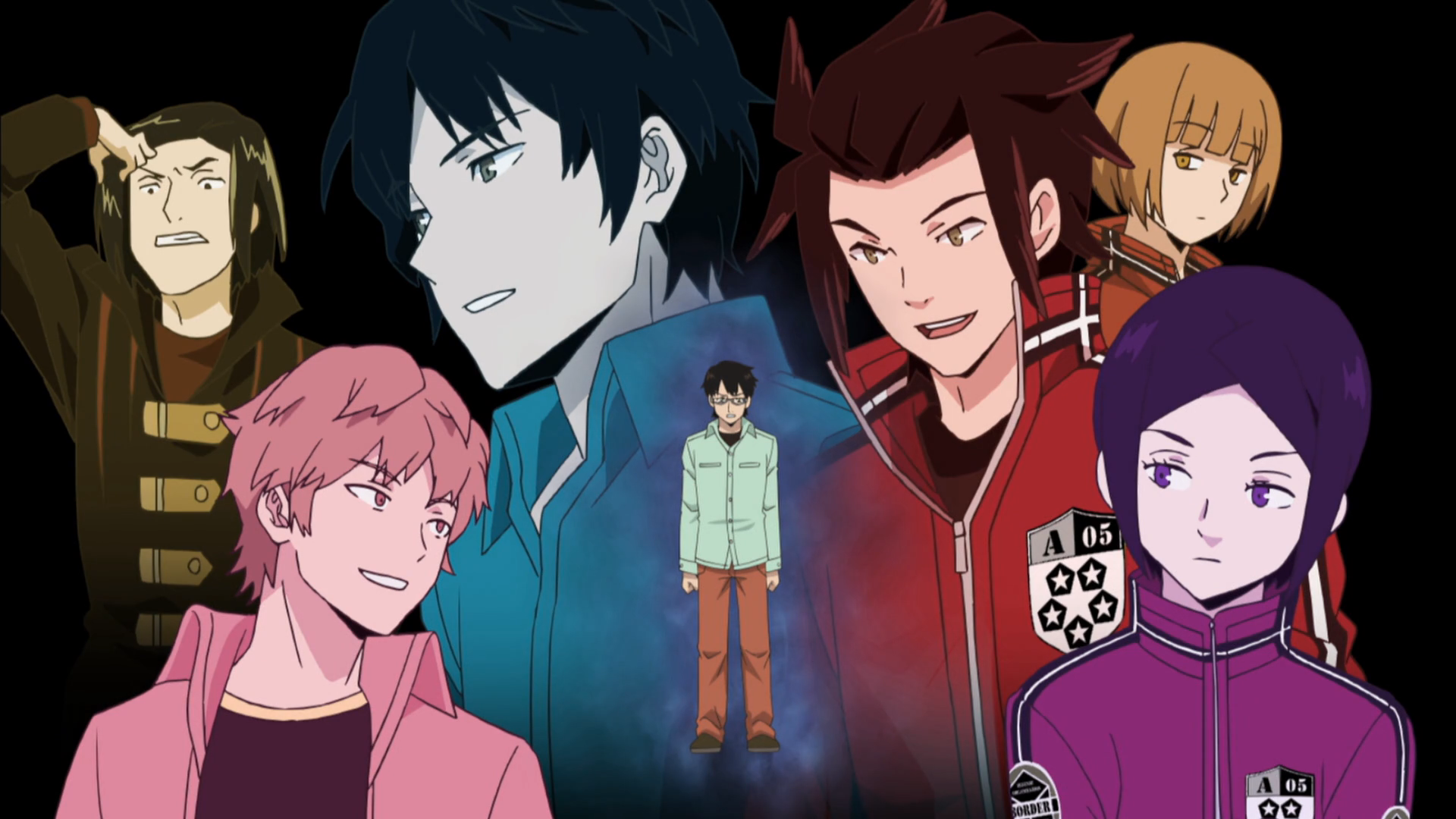
A boring, lame experience
Kitora was a huge jerk to Osamu for no other reason besides thinking he was coddled too much by everybody else. Chika always bailing out during the fights, rather than trying to help Osamu and Yuma, got on my nerves. Osamu’s half-fogged glasses.
Can’t say I liked the action with its boring shoot-outs. I did not have much in the way of romance to cheer for. Takeru’s “comedy” made me want to punch myself in the face. And don’t even get me started again on the show’s inept repetition.
Is this the worst anime that I have ever seen? Maybe. If nothing else, it is trapped at the bottom with the other lowest-execution anime.
World Trigger is a boring mess. The story is repetitive. The characters are stagnated. The art is lame. The music has no timing. The entertainment value is minimal. The anime is an ornament that shattered into seventy-three different pieces: worthless.
SUMMARY
Story: Terrible, horrible repetition, elongates seconds to minutes, and does not even have relevant narrative arcs
Animation: Bad, boring setting, below average actual animation, and okay character designs
Characters: Terrible, stagnation in Osamu, Yuma, Chika, and Jin’s characters prevent them from finding purpose or value
Sound: Terrible, bad ML’s, bad OST, bad VA performances
Enjoyment: Terrible, a running gag and a cat do not cover this year-and-a-half slog
Final Score: 1/10
Thanks for taking the time to read my review. If you want, take part in the discussion below! :3
 The Chuuni Corner
So basically, you confirmed you are the most unreliable source ever. After all, Xeno’s Arc is the worst Arc of them all. Yuma is the same age as Osamu, not younger. Its quite blatent you never paid attention to anything about the show, and I suspect you wrote this based only off of clips and preview images, except even with that you should have realized how bad this was.
0/10 for being clearly inaccurate on so many details it hurt my eyes to read.
LikeLike
I had the chance to come across this piece of review which was written nearly ten years ago, and I felt very compelled to agree on the other comment’s views – That whoever wrote this clearly hasn’t paid attention to this show.
“Repetition”
To start off with, I would actually like to point out some parts that I actually agree with this review, which is the repetition in this show.
The anime, in an attempt to lengthen the originally-not-long-enough story, had decided to use methods like placing the openings in every possible location, repeating previous scenes, adding the fun facts at the end and such. Which is why I tend to recommend people watching the manga which has none of the above problems (or maybe the new reboot will also be able to solve these problems. I have high hopes for that.). These are indeed flaws of this anime, every fan of World Trigger would admit that much.
However, I fully disagree with all other points you tried to make on the topic of “repetition”. Firstly, Yuma’s “pout” as you called it, also referred to as the “3-face”, has no problem with repetition. Like you said, it is a character trait. How is it supposed to be a trait if it doesn’t appear multiple times? I see nothing wrong with it being on screen, especially when it mostly appears only in casual scenes.
Secondly, the display of names. A common problem audiences of World Trigger found is being unable to recall the names of specific characters. That is not to say they aren’t memorable, just that the sheer number of characters made it difficult for many to sort everyone out. Displaying names and basic information of each character makes it much easier for the audience to make the connection and recall who they are respectively. Nothing wrong with this.
Thirdly, I don’t understand what you meant by “invariance of enemies”. If you have watched the show, surely you would have been told multiple times of the different Trion soldiers, all having different structure and function from each other. I won’t even bother mentioning the humanoid Neighbours here as they are clearly very different from each other.
Fourthly, about explanatory dialogues. While for other animes and mangas they may favour battle scenes over everything else, this is not the case in World Trigger. Battle strategy is everything here. And to explain everything going on in the scene, dialogues are definitely needed to show the audience the reasoning behind each character’s action. At the same time, World Trigger does tend to shape its character not only by their actions during battles, but also by their commentaries on the battles. Therefore, the explanatory dialogues are very much needed in this story.
Pacing
Pacing in the anime is admittedly a problem. It should be noted that the “Xeno-and-Lilith arc”, also called the Fugitive Arc, is an anime-only arc which most fans ignore its existence. You are completely spot on in how this arc halts the B-rank wars and has no consequence to the story. This arc simply wasn’t meant to be there, or actually wasn’t meant to exist at all. There is a reason why when fans recommend season 1 of World Trigger, it is a common practice to tell whoever is watching the show to skip the entire arc altogether and continue with the B-rank wars, which should never have been halted. I think this might have been due to some issues like the progress of the anime catching up with the manga and hence having nothing to write on until the manga releases new chapters, but correct me if I am wrong. Anyways, this arc is really bad and not considered a part of the story. If you have the time and resources, please do read the manga instead.
Settings
About the location where the story takes place, of course it is in the same city and headquarters. I’d be very concerned if they ended up giving up the headquarters so quickly in the show. Honestly, the main theme of this show is about protecting Mikado City, of course this show is going to take place in this city. As for the B-rank wars, they take place between Border agents, and where are they supposed to be if not in Border HQ itself? The fact that they have different maps for each war is novel enough. Details of each location are also quite abundant, they are there in the story, and it is not the anime’s fault if someone decided to overlook them.
For weapons, the fact that you said that they are mostly swords and shields with no distinguishing characteristics makes me question whether you have paid any attention to the anime, or watched the anime at all. If you have indeed watched all the repeated fun facts as you have mentioned, you should clearly know how different each weapon is from the other, and that there are definitely many types of guns and bullets other than swords and shields. Seriously, Osamu is a shooter and Chika is a sniper. I find their weapons way more than a “variant of swords and shields”.
For Trion Soldiers, if you find them featureless, you might as well haven’t watched the anime. Nobody would have a hard time differentiating a Rabbit from a Bander, and Ilgar from a Rad. They all have their own very distinctive features and I do suggest you take a quick trip to wiki if you want to know the specifics.
About the Black Triggers, sure they are unique, but their uniqueness does not equate to the other weapons not designed with care and attention. One of uniqueness of this entire show is how everyone, especially in the ranks wars, uses a similar set of weapons. Winning or losing is not about using a stronger weapon to beat a weaker one, but to choose your weapon strategically and fight others based on how well you can wield whatever you possess. The rank wars are a splendid example of that.
Character design
Jin is one of the most important characters in World Trigger, predicting invasions and scheming in the background to achieve the best outcome. The part where he gave up his Black Trigger, Fujin, is very important in both the story and his characterisation. It is the first time we see a part of Jin under his Talented Elite mask, that while he knows giving up Fujin was the best choice of action, parting with the Black Trigger left by his mentor Mogami was still hard for him. It is also where we see the effects of the plans and decisions Jin made with the help of his Side Effect: Giving up Fujin ensured the enlistment of Yuma who proves to be an invaluable asset especially in the Large-Scale Invasion Arc, guaranteed that Miwa can aid in the end of the war when Jin himself was occupied with Hyuse on the other side of the battlefield. This difficult decision had in no way “reduced his overall impact and coolness”.
The claim of Jin vanishing in the arc without making any impact is definitely a false one that can be easily disproved by anyone who actually watched the anime. If anything, Border’s response in the entire arc was orchestrated by Jin. Jin, with his Side Effect, was the one to contact Tamakoma First and Miwa to help Osamu reach the base and end the invasion. Jin, with his Side Effect, was the one who had to make the difficult decision of placing Osamu and Chika in danger in order to keep their enemies from civilians. Jin was essentially behind everything in this arc, and I found the claim to him not making an impact absurd. Without Jin, this arc would have probably ended with Chika alongside with many high-ranked agents abducted and many civilians injured or dead.
Also, Jin was not the one who inspired Osamu to join Border. If you watched the end of the Large-Scale Invasion Arc, you would know for a fact that Osamu wanted to join to protect Chika, and Jin was the one Osamu met after he snuck into the forbidden areas and was nearly killed by a Neighbour. I don’t think the anime or the manga specified what happened afterwards, but the ongoing theory is that Jin played a part in getting Osamu into Border after he saw Osamu and his future.
Jin is a more secretive character, but we do know a bit of his background as an agent of the Old Border trained by Mogami. He does happen to have an internal conflict, especially at the end of the Large-Scale Invasion Arc where he apologises for placing Osamu in danger in order to achieve a better overall future. It is hard not to have an internal conflict when his Side Effect is Foresight. He plays a major role in the story, being the one who overlooks and plans everything. Of course, his role in the rank wars is relatively less than the other main characters given that he is not a B-rank agent and hence wouldn’t participate as such, but that doesn’t make him sidelined or any less as a main character when he is the one who made the greatest overall impact in the story.
Going on to Yuma. I find it difficult to understand what you meant by Yuma “not having any notable interactions with the rest of the cast, including Osamu and Chika”. Yuma literally stayed for Osamu and Chika. Yuma, finding the part in Osamu which he relates to his father’s actions, decided to help Osamu in his quest to help Chika join the Away Mission. Those are quite notable interactions in my eyes.
Now let’s speak of Osamu. Osamu is easily one of the best-written characters in World Trigger. He is weak, that’s for sure. His weakness roots deeply in his settings, and it isn’t something he could change easily at will. He lacks the talent others have, namely the Trion level he has. And as you’ve said, World Trigger took a realistic approach when dealing with Osamu. He is not the typical shounen manga protagonist you see who might have initially been but then proceed to overcome their weakness by powers of friendship, by hidden blood lines, by random surges of power. Osamu is weak, and he acknowledges it. That doesn’t mean his development is stagnant. Osamu recognises his weakness, and actively tries to find methods to fight while having such weaknesses. He tries to come up with plans when his strength is insufficient. He makes unexpected moves when he is clearly weaker than his opponents. Time is ticking for Osamu, and he has to put his priorities straight when others are also improving at a much faster speed than him. He has to learn from his previous mistakes and find ways to overcome them. At the same time, his opponents are also learning from them and devising new plans to counter their attacks. The B-rank wars show the development of the entire Border, with each squad placing in their efforts to improve themselves. It is as far as it can be from the term “stagnation”.
The biggest problem, again, is the anime’s pacing. The long season was never intended for the story, and the anime attempted to elongate the originally well-paced manga to fit the screen time of the anime.
Parts the reviewer doesn’t like
Firstly, the part about Kitora. She indeed wasn’t treating Osamu with the best attitude, but it wasn’t without reason. Her attitude comes with her character, where she looks for competition with those of her same age, and when she met Osamu, a C-ranker who seemingly defeated two Marmods, made her wanting to compete with him while wanting to have the assurance that she, as an A-ranker is the better of the two. After Osamu showed himself to not be the arrogant person she initially assumed him to be, Kitora treated Osamu in a much better way. Sure, Kitora’s behaviour wasn’t the best, but it was a conflict rooted in her character, not without reason, and definitely not because she felt Osamu was “coddled too much by everybody else”.
Secondly, about Chika. Chika was initially more on the side of being the character to be protected by others. She depends a lot on Osamu and Yuma, she finds it difficult to actually shoot at people. But she tries to find a solution. She eventually uses lead bullets to shoot but not kill. But her inability to kill makes it impossible for her to score when the other two are already gone, and so her only solution is to bail out. This is not the end of her story though. She eventually had her own chapter on reflections, development and made a change. But that’s spoilers for the other seasons and I will not go further. Just keep in mind that everyone starts from somewhere and works to solve the obstacles on their way. That’s what we call character development.
Thirdly, Osamu’s glasses. I actually have not much to say here except for questioning the number of anime/ manga you’ve watched. That’s just a common artistic representation, nothing special. If you felt the need to mention that you dislike that, you might have a hard time watching a bunch of other animes like Detective Conan.
Lastly, the lack of action was a fault of the animation of season 1 only. You can see very good action in the other seasons. And the tiny bits of romance you want to see are also there.
Conclusion
If World Trigger Season 1 was the worst anime you have watched, then you have clearly not seen enough anime. Pick a random anime and you will find much more problems with animation than World Trigger. Pick a random long-running show and you will find similar problems in pacing. Find an anime better than World Trigger that has settings from weaponry to character, that takes character development seriously, that keeps a massive cast alive and you will take a long time to do so. World Trigger is a unique and beautiful piece of its own, a masterpiece I have yet to find another manga/ anime that it is similar with. If you live in a world where World Trigger happens to be the worst anime you have ever seen, then I would really want to enter that world of yours. It surely sounds like a utopia very different from ours if every anime is that good.
World Trigger, despite the flaws in its season 1 anime, is still a very underrated masterpiece that I greatly enjoyed as I spent time watching and re-watching it over and over again. Again, I highly recommend everyone who comes across this comment to read World Trigger’s manga.
P.S. Never thought I would spent so much time discussing on a review years ago, but I guess this shows how much World Trigger means to me.
LikeLike